India Flood Preparedness 2026: State-Wise Alerts, Relief Helplines and a Practical Family Safety Checklist
Stay safe during the 2026 monsoon with our guide to India's new flood warning systems, state helplines, and a professional-grade home evacuation checklist.
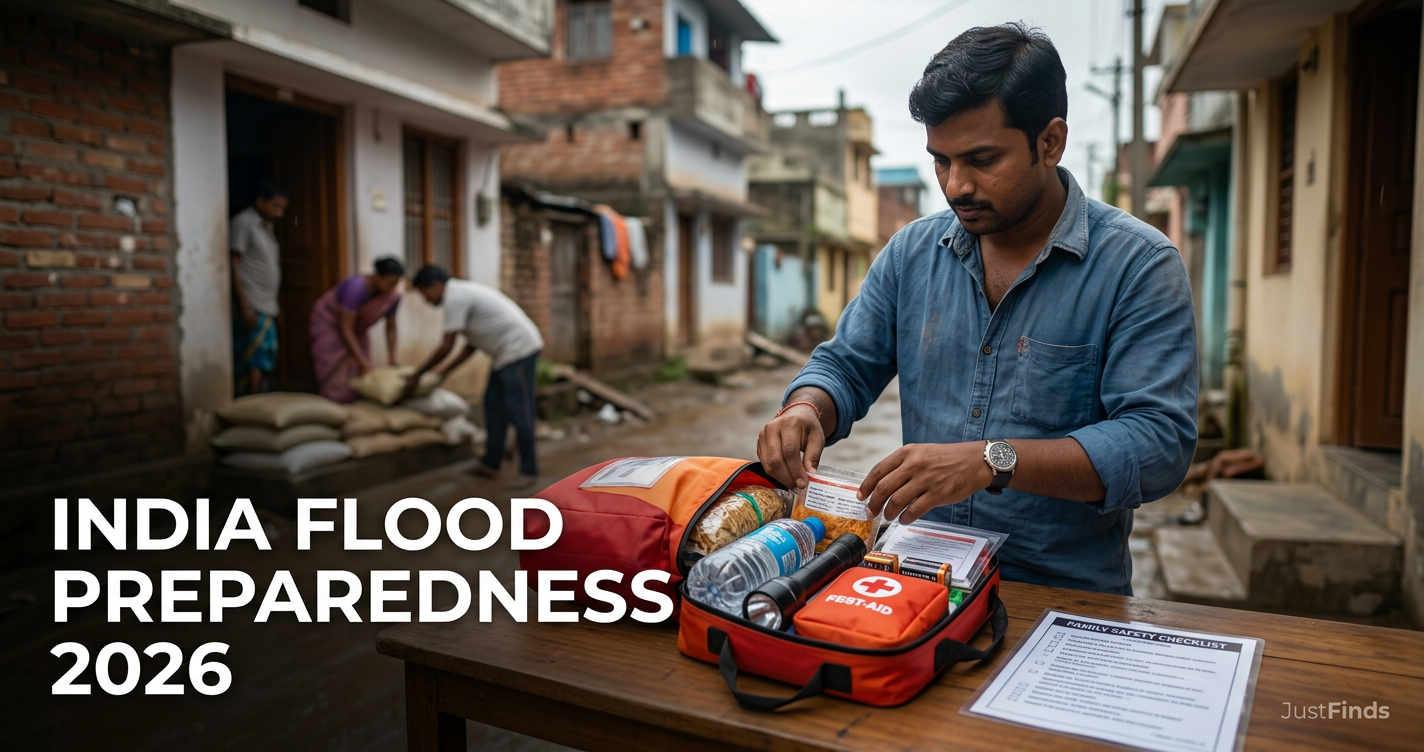
India flood preparedness for 2026 requires monitoring the Central Water Commission’s (CWC) real-time inundation data as regional flooding intensifies this August. Residents must utilize the integrated IMD-CWC warning systems to secure households and livestock before water levels breach local embankments.
1. The 2026 Flood Landscape: Understanding India’s New Warning Infrastructure
The Central Water Commission (CWC) and the India Meteorological Department (IMD) have fully integrated their systems as of March 2026. This synchronization ensures that district-wise warnings are updated four times daily, providing a rolling seven-day forecast outlook for every vulnerable region.
Reliable monitoring now relies on a network of 350 forecasting stations. This includes 150 inflow stations located at major dams and barrages, alongside 200 level stations that track river height in real-time. This infrastructure allows authorities to predict surges before they reach residential clusters.
The "Flood Watch India" ecosystem, accessible via a mobile app since late 2023, now monitors over 500 stations. Users can check the storage status of 150 major reservoirs directly from their smartphones, providing a transparent view of water management during heavy discharge periods.
Actionable Advice: Download the 'Flood Watch India' app and set 'Station-wise' alerts for the three nearest river gauging stations to your home. This gives you a direct lead time on upstream discharge before it reaches your local drainage system.
2. Deciphering the Common Alerting Protocol (CAP)
India has standardized its emergency messaging through the Common Alerting Protocol (CAP). This system pushes critical data simultaneously across SMS, social media, and local radio to ensure no community is left uninformed during a crisis.
Color-Coded Severity - Yellow: Be Aware. This indicates a potential for worsening conditions; stay tuned to local news. - Orange: Be Prepared. There is a high likelihood of severe weather or significant inundation in your area. - Red: Take Action. This signifies extreme danger where evacuation is likely mandatory and immediate.
For residents in the Godavari, Tapi, and Mahanadi basins, the "C-Flood" platform provides hyper-local accuracy. It offers village-level inundation forecasts 48 hours in advance, allowing families to move assets to higher ground before the first wave arrives.
Maritime safety has also seen a tech upgrade. Fishermen in the deep sea receive specialized weather warnings through the NAVIC satellite navigation system via INCOIS and All India Radio broadcasts, ensuring safety even far from land-based cellular towers.
Actionable Advice: If you receive a 'Red Alert' via SMS, do not wait for rain to start. Immediately move your vehicle to a pre-identified multi-story parking lot or a natural elevation above the 100-year flood line.
3. State-Wise Relief Helplines & International Emergency Contacts (August 2026)
Following the catastrophic flash flood on the Nepal-Tibet border on August 27, 2026—which resulted in at least 160 deaths—emergency helplines have been prioritized for cross-border and state-level coordination.
| Region / Authority | Contact Number(s) | Notes | | :--- | :--- | :--- | | Karnataka State | 1070 / 080-22253707 | 24/7 State Control Room | | Kerala (NoRKA-Roots) | 1800 425 3939 / +91 88020 12345 | Toll-free & Missed Call Service | | Telangana (Delhi Bhavan) | 9871999044 / 9949351270 | For residents stranded near NCR | | Indian Embassy Nepal | +977 985 131 6807 / +977 970 910 7500 | Border flood assistance | | Indian Embassy Beijing | +86 185 1428 4905 | WhatsApp enabled for Tibet border | | Nepal Tourism Board | 1234 / 1144 | Hotline for travelers |
Actionable Advice: Save these numbers as 'Emergency - [State Name]' in your phone contacts now. During a network surge, searching for a number online consumes battery and bandwidth you cannot afford to lose.
4. The Practical Family Safety Checklist: Pre-Flood Planning
Step 1: Risk Assessment Consult your local planning department or a county geologist to determine if your home sits in a flash-flood or landslide-prone zone. If you live near the Godavari basin, use the C-Flood app to identify the specific elevation of your village relative to the riverbank.
Step 2: The Communication Blueprint Designate one out-of-state relative as your "Family Contact." In a disaster, local lines are often jammed, but long-distance calls may go through. Establish a physical meeting place outside the flood zone and register any household members with disabilities with local authorities now.
Step 3: Evacuation Drills Identify and practice at least two routes to high ground. Learn the difference between local community sirens and the SMS alert patterns sent via the CAP system so you can react without hesitation when a Red Alert is issued.
Actionable Advice: Conduct a 'dry run' evacuation at night. Flood conditions often involve power outages; knowing your exit path in total darkness is a vital survival skill.
5. Flood-Proofing Your Home: Engineering and Maintenance
Structural preparation can significantly reduce recovery costs. Raise all electrical switches, sockets, and circuit breakers at least 12 inches above the projected flood level for your specific area. This prevents short circuits and fire hazards when water enters the structure.
Install backflow valves in all toilets and floor drains to prevent sewage from backing up into the home. Ensure that your sump pump is tested monthly and equipped with a reliable battery backup system to handle power outages.
Fuel security is often overlooked. Anchor any outdoor fuel tanks to the ground. Floating tanks can rupture, leading to massive soil contamination or downstream damage to other structures. Before you evacuate, follow this protocol: unplug all electronics, shut off the main gas valve, and kill the primary water and electricity supply.
Actionable Advice: Buy a heavy-duty 'dry bag' for your property deeds, insurance papers, and identification. Store this bag in the highest point of your home, such as an attic or a top-shelf cupboard, rather than a ground-floor safe.
6. The 2026 Emergency Kit: Essentials for Survival
A modern survival kit must address both immediate safety and long-term health. Include heavy-duty rubber boots and waterproof gloves to handle debris. Pack insect repellent containing DEET or Picaridin to protect against the surge in vector-borne diseases that follows heavy rains.
Maintain a secondary emergency kit in your vehicle. This should contain road flares, booster cables, and sleeping bags. Ensure your home has a portable fire extinguisher that is easily accessible; every family member should know how to operate it using the P.A.S.S. technique.
Actionable Advice: Include a 10,000mAh power bank and a hand-crank radio in your kit. Information is your most valuable asset when the cellular grid fails.
7. Post-Flood Recovery and Sanitation Protocols
Never assume floodwater is clean. To disinfect hard surfaces, use a ratio of 1 cup of bleach to 1 gallon of water. Scrub all floors and walls that came into contact with water to prevent toxic mold growth.
Follow the "Discard" rule for porous materials. Drywall, rugs, and upholstered furniture that have been soaked in floodwater generally cannot be fully disinfected and should be thrown away. These items trap bacteria and chemicals that boiling or simple washing cannot remove.
For financial recovery, document all damage immediately with photos. The State Disaster Response Fund (SDRF) provides immediate relief, while the State Disaster Mitigation Fund (SDMF) focuses on long-term structural repairs. Contact your district magistrate’s office to initiate claims under these funds.
Actionable Advice: Before beginning cleanup, take a video walkthrough of every room. Insurance adjusters and SDRF officials require visual proof of the water line on the walls to process high-value claims.
Expert Recommendation: Based on the current 2026 weather patterns, the most common mistake is waiting for a visible rise in water before evacuating. Use the C-Flood app's 48-hour window to leave early. It is better to spend two days in a shelter unnecessarily than to be trapped on a rooftop awaiting a helicopter rescue.
Frequently asked questions
›What is the best app for real-time flood updates in India?
The 'Flood Watch India' mobile app is the primary tool for 2026. Launched by the CWC, it provides real-time data from over 500 monitoring stations and tracks the storage levels of 150 major reservoirs, giving users a direct view of potential flood risks in their specific vicinity.
›How far in advance can village-level floods be predicted?
The C-Flood platform currently offers inundation forecasts up to 48 hours (two days) in advance. This service is specifically available for the Godavari, Tapi, and Mahanadi River basins, providing village-level granularity that allows for localized evacuations and asset protection before the water arrives.
›What should I do if I am caught in a flash flood while driving?
Do not attempt to drive through water. Just six inches of water can stall a car, and two feet can sweep most vehicles away. If water rises around your car, abandon it immediately and move to higher ground on foot if it is safe to do so.
›Who provides weather warnings for fishermen in the deep sea?
Warnings for deep-sea fishermen are broadcast via All India Radio and the NAVIC satellite navigation system. These alerts are managed by INCOIS to ensure that those beyond the reach of mobile towers receive timely information regarding cyclones and high-wave alerts.
›What is the difference between the SDRF and SDMF?
The State Disaster Response Fund (SDRF) is designed for immediate relief and response during a disaster. The State Disaster Mitigation Fund (SDMF) is focused on long-term projects and strategies to reduce the impact of future disasters, such as building embankments or improving drainage systems.
›How often does the IMD update its district-level warnings?
The India Meteorological Department (IMD) updates its district-wise early warnings four times daily. These updates provide a forecast outlook for up to seven days, allowing local administrations and residents to track the progression of weather systems and prepare for potential flooding.
›Are there specific helplines for Indians affected by the 2026 Nepal floods?
Yes, following the August 2026 events, the Indian Embassy in Nepal has active helplines at +977 985 131 6807 and +977 970 910 7500. Additionally, the Nepal Tourism Board provides assistance via the 1144 hotline for travelers and tourists in the region.
›How high should I move my appliances to keep them safe?
All electrical components, including switches, sockets, and circuit breakers, should be raised at least 12 inches above the projected flood level for your area. This height helps prevent electrical fires and equipment damage during minor to moderate inundation events.
›Can I use floodwater for cleaning if I boil it?
No. Floodwater often contains hazardous chemicals, heavy metals, and raw sewage that boiling cannot remove. For disinfecting hard surfaces, use a dedicated solution of 1 cup of household bleach mixed with 1 gallon of clean water to ensure all pathogens are destroyed.
›What is the 'Common Alerting Protocol' (CAP)?
CAP is a standardized digital format for exchanging emergency alerts. In India, it allows the government to send consistent warning messages across SMS, social media, radio, and television simultaneously, ensuring that the maximum number of people receive life-saving information in real-time.
Sources referenced
More in News
Nepal and China Flood Disaster 2026: Death Toll, Missing Count, Tunnel Rescue and Rebuilding Cost Explained
Massive glacial collapse in the Himalayas triggers a $5 billion disaster, leaving thousands missing and hundreds dead across Nepal and Tibet.
World Natural Disasters Right Now (August 2026): Live Flood, Landslide, and Storm Emergencies
Global emergencies peak in August 2026 with a massive Nepal glacial collapse, Cyclone Dolphin, and a 7.4 earthquake in Colombia as sea temperatures hit record highs.
Nepal Glacial Flash Flood 2026 and the Bihar-UP Gandak Basin Alert: Causes, Downstream Risk and Preparedness
A catastrophic GLOF in Nepal has triggered a 9-meter surge, putting Bihar and Uttar Pradesh on high alert as a secondary lake threatens the Gandak basin.
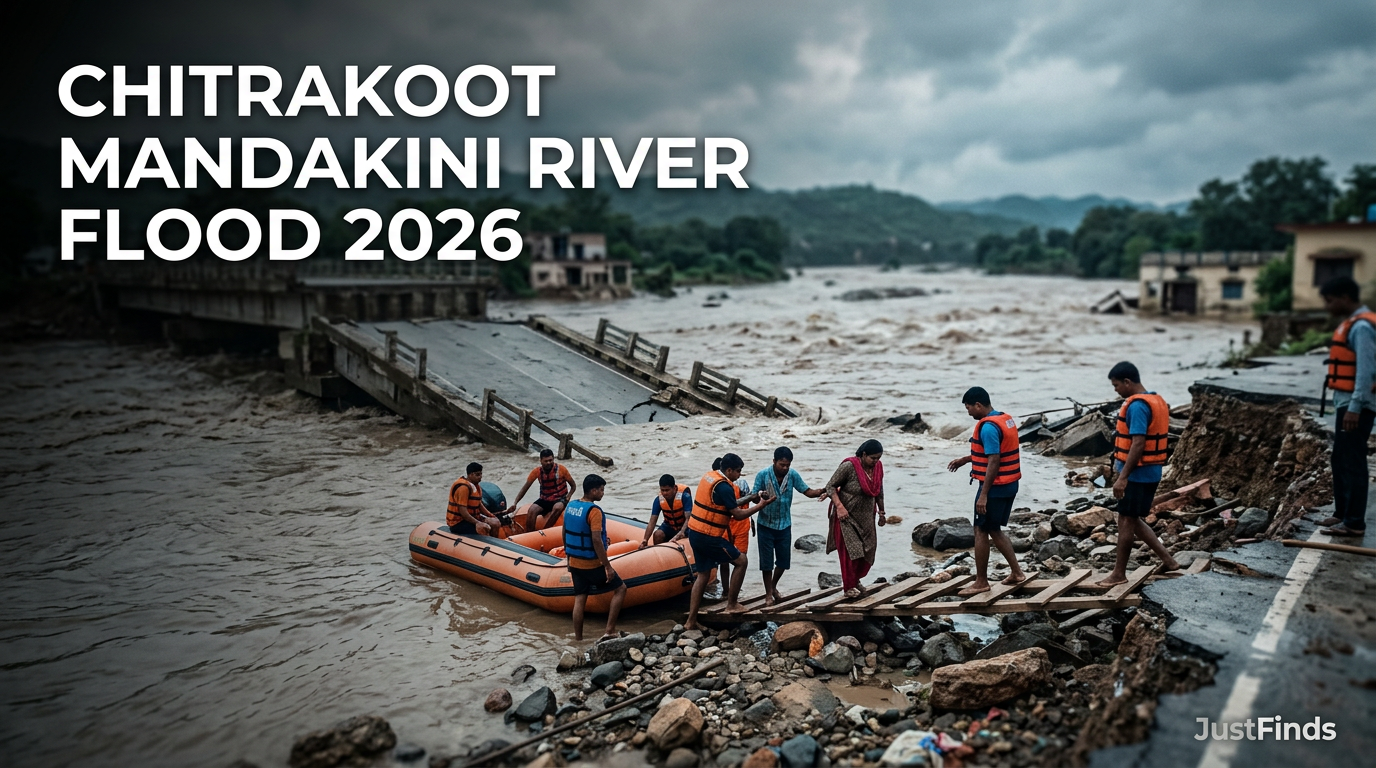
Chitrakoot Mandakini River Flood 2026: Bridge Washed Away and Rescue Updates
Mandakini River breaches 23-year record in Chitrakoot as Gorgi Dam failure washes away Ramghat bridge and triggers IAF-led rescue operations.