World Natural Disasters Right Now (August 2026): Live Flood, Landslide, and Storm Emergencies
Global emergencies peak in August 2026 with a massive Nepal glacial collapse, Cyclone Dolphin, and a 7.4 earthquake in Colombia as sea temperatures hit record highs.
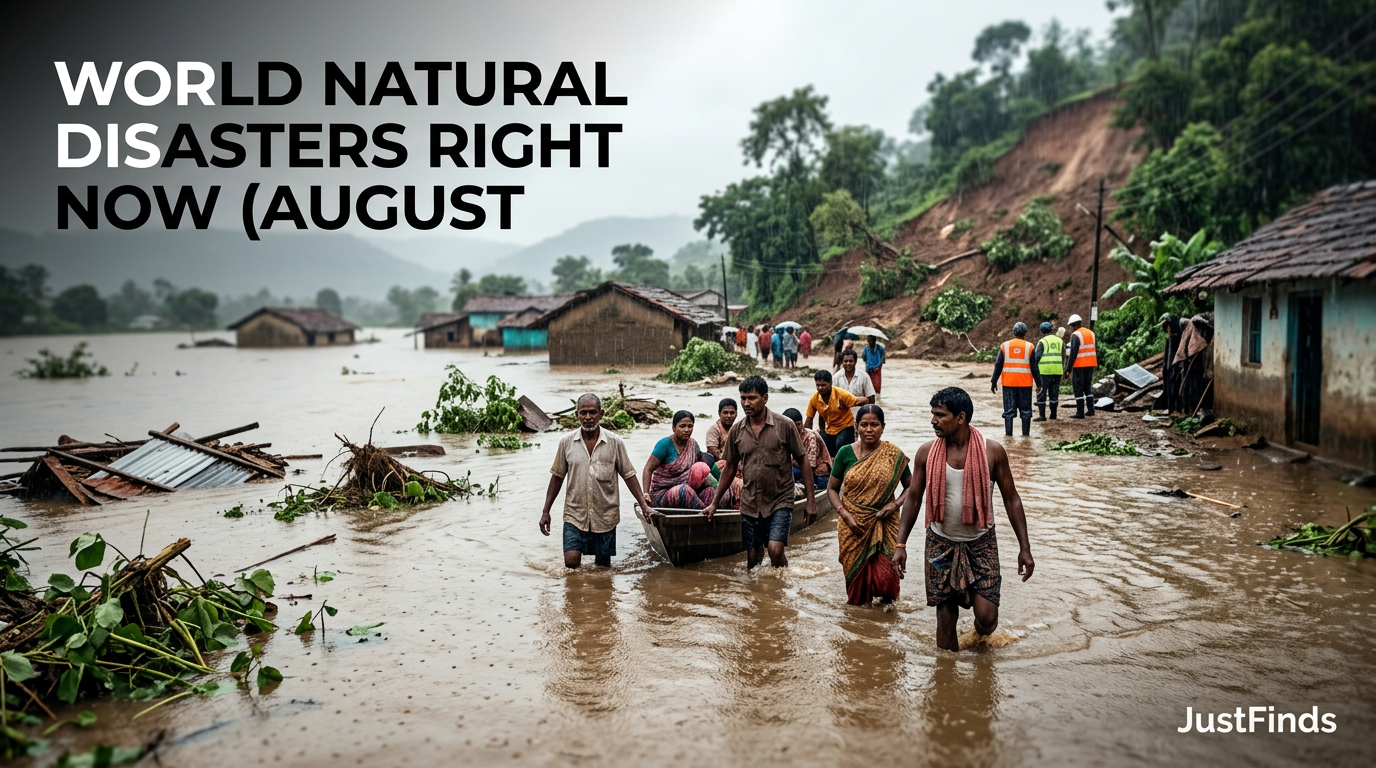
As of late August 2026, the planet is experiencing extreme climate volatility driven by record-breaking sea surface temperatures of 21.1°C. The most critical world natural disasters right now include a catastrophic glacial collapse on the Nepal-China border, the landfall of Cyclone Dolphin in East Asia, and a massive 7.4 magnitude earthquake in Colombia.
Global response teams are currently leveraging satellite-based monitoring to coordinate rescues across four continents. These efforts are vital as agencies track live flood, landslide and storm emergencies to mitigate further loss of life during this high-risk period.
1. The Himalayan Crisis: Glacial Collapse at Langtang Lirung
The most severe event of August 2026 occurred on August 26 at 10:30 a.m. local time. A 2,000-foot-wide section of glacier and rock sheared off near the Nepal-China border, leaving a massive 3,000-foot gash in the peak of Langtang Lirung.
This was not a standard avalanche. The collapse was so violent that the USGS initially flagged the impact as a 4.4 magnitude earthquake. The resulting wave of water, ice, and rock became a high-speed debris surge that gave downstream residents almost no time to react.
The 7-Minute Surge 1. Shear Event: A 2,000-foot-wide block of ice and rock breaks away from the mountain. 2. Initial Descent: The debris wave travels the first 13.7 miles of the valley. 3. Terminal Speed: The mass maintains an average speed of 120 mph, obliterating settlements in under seven minutes.
Actionable Advice: If you are trekking in the Langtang region, carry a personal locator beacon (PLB) with satellite messaging, as cellular towers in the valley floor were destroyed within the first three minutes of the surge.
International agencies are currently struggling to verify the total casualty count. While The Salvation Army reports 104 deaths, CNN has reported the toll has passed 469. Estimates for missing persons range between 1,300 and 1,400, including dozens of Americans and Australians.
2. Cyclone Dolphin and the Asian Monsoon Surge
Cyclone Dolphin has remained unusually resilient after a 4,000-mile trek across the Pacific Ocean. It is currently the most powerful storm of 2026, paralyzing the southeastern coast of China and the Philippines.
In China, the storm forced the evacuation of over 1 million people. Shanghai has seen its aviation hub grind to a halt with over 1,000 flights cancelled. In the Philippines, monsoon rains amplified by Dolphin have triggered floods and landslides across 33 provinces.
Sri Lanka is also facing a double blow. While still recovering from Cyclone Ditwah, the country experienced heavy rainfall on August 4 that triggered new mudslides. These slides killed 7 people and destroyed 291 homes in mountainous regions.
Practical Step: Residents in the path of Dolphin should utilize the "Windy" or "Zoom Earth" apps to track real-time satellite wind shear, as local radar stations in the Philippines are currently experiencing intermittent power failures.
3. The 7.4 Magnitude Earthquake in Colombia
On August 10, 2026, the western region of Colombia was rocked by a massive 7.4 magnitude tectonic shift. Unlike the weather-driven events in Asia, this geological disaster struck urban centers directly, causing immediate structural failure.
Significant building collapses occurred in the high-density cities of Bogota and Cali. At least 111 deaths have been confirmed so far. Rescue operations are focusing on clearing rubble in historic districts where older structures failed to meet modern seismic codes.
Safety Protocol: If you are in Bogota, avoid the Candelaria district where unreinforced masonry is unstable. Use the official 'Sismo Colombia' alert system for updates on aftershocks, which have reached magnitudes of 5.2 as recently as this morning.
4. North American Wildfire Season: The "Spokane-British Columbia" Arc
Record heat and dry conditions have ignited a corridor of fire stretching from Canada down to the American Southwest. This season has seen unprecedented acreage destroyed as fire crews struggle with simultaneous ignitions.
In British Columbia, Canada, the Bald Range Fire and Bradley Creek Fire forced 20,000 people to flee their homes starting August 7. South of the border, the situation is equally dire:
- Oregon: A staggering 2.3 million acres have burned this season as of August 10.
- Washington: The Spokane Complex is currently threatening suburban infrastructure.
- Nevada: A State of Emergency is active for the Hawk Fire near Reno as of August 24.
Actionable Advice: Homeowners in the Spokane Complex zone should immediately clear gutters of pine needles and move flammable patio furniture at least 30 feet from structures to prevent ember ignition.
August 2026 Major Emergencies Comparison
| Location | Disaster Type | Key Date | Primary Impact | | :--- | :--- | :--- | :--- | | Nepal-China | Glacial Flash Flood | Aug 26 | 1,300+ Missing; 120mph debris wave | | China | Cyclone Dolphin | Aug 25 | 1M+ Evacuated; Shanghai air travel halted | | Colombia | 7.4 Earthquake | Aug 10 | 111 Dead; Urban infrastructure collapse | | British Columbia | Wildfire | Aug 7 | 20,000 Evacuated; Bald Range Fire | | Oregon, USA | Wildfire | Ongoing | 2.3 Million acres burned in 2026 | | Hawaii, USA | Tropical Storm Moke | Aug 23 | State of Emergency for Hawaii County | | France | Pomas Tornado | Aug 25 | Multiple injuries; significant property damage |
5. The Role of Space-Based Technology in Live Response
To manage these simultaneous world natural disasters right now, agencies are relying heavily on Earth-observing satellites. NASA and NOAA utilize the Suomi NPP, NOAA-20, and NOAA-21 platforms to collect real-time data on heat signatures and flood paths.
For the Nepal disaster, scientists used Planet Labs and Landsat imagery to identify the 2,000-foot-wide section that sheared off. This allowed for better prediction of secondary landslides. NASA has noted that Suomi NPP data will cease on November 1, 2026, forcing a shift to newer NOAA-21 platforms mid-disaster season.
Technical Tip: Emergency managers can access the NASA FIRMS (Fire Information for Resource Management System) dashboard to view 375m resolution thermal anomalies updated every three hours for the Oregon and Washington fires.
6. Humanitarian Crises and Global Aid Mobilization
Beyond natural disasters, man-made crises are complicating relief. In Haiti, the Viv Ansanm gang coalition controls 90% of the capital. This has left 600,000 people in famine-level conditions and 52% of the population facing severe food insecurity.
In the U.S., FEMA is maintaining a force of 4,000 reservists to manage the Hawk Fire and Spokane Complex emergencies. Internationally, the U.S. has signaled intent to assist Nepal, while groups like The Salvation Army and the Center for Disaster Philanthropy (CDP) are mobilizing recovery funds for the Pomas tornado in France and the Sri Lankan floods.
Expert Takeaway: The convergence of the Nepal glacial collapse and Cyclone Dolphin highlights how warming oceans are altering high-altitude and coastal stability. If you are in an affected zone, prioritize satellite-informed evacuation routes, as traditional ground-based warnings cannot keep pace with 120 mph debris flows.
Frequently asked questions
›What caused the Nepal-China flood on August 26?
A massive 2,000-foot section of a glacier near Langtang Lirung peak collapsed at 10:30 a.m., creating a high-speed wave of ice and rock. This event was so powerful it initially registered as a 4.4 magnitude earthquake on USGS sensors before being identified as a glacial flash flood.
›How many people are missing in the Nepal disaster?
Estimates for missing persons range from 1,300 to over 1,400 individuals. Casualty reports are currently conflicting, with CNN reporting over 469 deaths while other agencies like The Salvation Army cite 104. The search is complicated by the fact that at least 700 foreigners are among the unaccounted.
›Is Cyclone Dolphin still active?
Yes, Cyclone Dolphin remains a major threat after making landfall on China's southeastern coast. It traveled 4,000 miles across the Pacific and is considered the most powerful storm of 2026. It has grounded over 1,000 flights in Shanghai and intensified monsoon flooding across 33 provinces in the Philippines.
›What was the magnitude of the Colombia earthquake?
The earthquake that struck western Colombia on August 10, 2026, measured 7.4 on the Richter scale. The quake caused significant damage to urban infrastructure in Bogota and Cali, resulting in at least 111 confirmed deaths as rescue teams continue to search collapsed historic buildings.
›How many acres have burned in Oregon this year?
As of August 10, 2026, Oregon has recorded a staggering 2.3 million acres burned. This is part of a wider wildfire arc including the Spokane Complex in Washington and the Bald Range Fire in British Columbia, which forced 20,000 people to evacuate their homes earlier this month.
›What is Tropical Storm Moke?
Tropical Storm Moke is a weather system that prompted a State of Emergency declaration for Hawaii County around August 23, 2026. It is one of several active tropical emergencies currently being monitored by NASA and NOAA satellites to coordinate local emergency response and evacuations.
›Why was the Nepal disaster mistaken for an earthquake?
The sheer force of the 2,000-foot-wide glacial section shearing off Langtang Lirung peak created seismic vibrations. These vibrations were strong enough to be picked up by USGS monitoring equipment as a 4.4 magnitude earthquake before satellite imagery from Planet Labs confirmed the event was a glacial collapse.
›What is the current situation in Haiti?
Haiti is facing a severe humanitarian crisis where the Viv Ansanm gang coalition controls 90% of the capital. This has led to 52% of the population suffering from severe food insecurity, with approximately 600,000 people currently living in famine-level conditions as international aid struggles to reach them.
›Which satellites are being used to track these disasters?
NASA and NOAA are utilizing the Suomi NPP, NOAA-20, and NOAA-21 satellites to provide real-time data. These platforms track heat signatures for wildfires and flood progression. However, Suomi NPP data services are scheduled to cease on November 1, 2026, requiring a transition to newer satellites.
›How fast did the Nepal floodwaters travel?
The debris wave, composed of ice, rock, and water, traveled the first 13.7 miles at an average speed of 120 mph. This incredible velocity meant the surge covered the distance in under seven minutes, leaving almost no time for downstream settlements to evacuate.
Sources referenced
More in News
India Flood Preparedness 2026: State-Wise Alerts, Relief Helplines and a Practical Family Safety Checklist
Stay safe during the 2026 monsoon with our guide to India's new flood warning systems, state helplines, and a professional-grade home evacuation checklist.

Nepal and China Flood Disaster 2026: Death Toll, Missing Count, Tunnel Rescue and Rebuilding Cost Explained
Massive glacial collapse in the Himalayas triggers a $5 billion disaster, leaving thousands missing and hundreds dead across Nepal and Tibet.

Nepal Glacial Flash Flood 2026 and the Bihar-UP Gandak Basin Alert: Causes, Downstream Risk and Preparedness
A catastrophic GLOF in Nepal has triggered a 9-meter surge, putting Bihar and Uttar Pradesh on high alert as a secondary lake threatens the Gandak basin.
Chitrakoot Mandakini River Flood 2026: Bridge Washed Away and Rescue Updates
Mandakini River breaches 23-year record in Chitrakoot as Gorgi Dam failure washes away Ramghat bridge and triggers IAF-led rescue operations.